
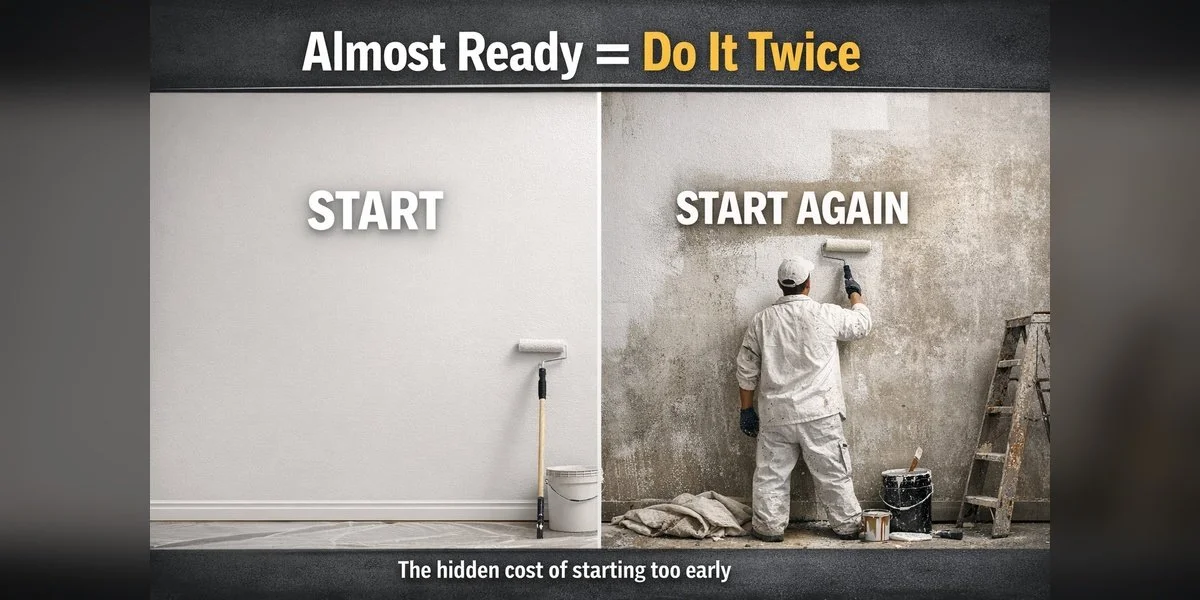
"Almost Ready" Is Costing You More Than You Think
The Hidden Cost of “Almost Ready”
Walk any jobsite and you’ll hear it:
“You can go ahead and get started.” “It’s almost ready.”
That mindset costs more jobs than bad labor ever will.
“Almost ready” is not ready
Painting depends on everything in front of it being complete.
When it’s not, the work doesn’t slow down—it breaks.
You lose the sequence: patch → prime → paint
And once that sequence is gone, efficiency goes with it.
You’re not finishing work—you’re starting it twice
Every time a crew has to leave and come back:
Setup happens again
Protection gets redone
Materials get handled twice
That time doesn’t show up on a schedule. But it shows up in labor.
Stop-and-start kills production
Painting works best in a flow.
When areas aren’t ready, crews:
Wait
Skip around
Work out of sequence
You don’t just lose time—you lose rhythm.
And production drops fast after that.
It creates rework (whether you track it or not)
Other trades damage finished work
Dust affects coatings
Touch-ups turn into repainting
Most of this never gets labeled as rework. It just gets absorbed into the job.
It gives a false sense of progress
Paint on the wall looks like progress.
But if the area isn’t ready, you’re not completing work—you’re revisiting it.
Real progress is finishing areas once.
The jobs that run best do this differently
The smoothest projects wait until areas are actually ready.
That’s how you get real flow.
On Johnston Hall, we sequenced patching, priming, and painting properly and finished in half the allotted time because the work never had to stop and restart .
That wasn’t speed. That was efficiency.
What “ready” actually means
Drywall complete and sanded
Clean workspace
Full access
No return work above finished surfaces
Anything short of that isn’t ready.
The takeaway
Starting early feels like gaining time.
Most of the time, it’s just creating rework.
The fastest jobs don’t start sooner. They start when the work is actually ready—and finish it once.