
Case Study: Johnston Hall Repairs - Fort Gordon (Building 29818)
Executive Summary
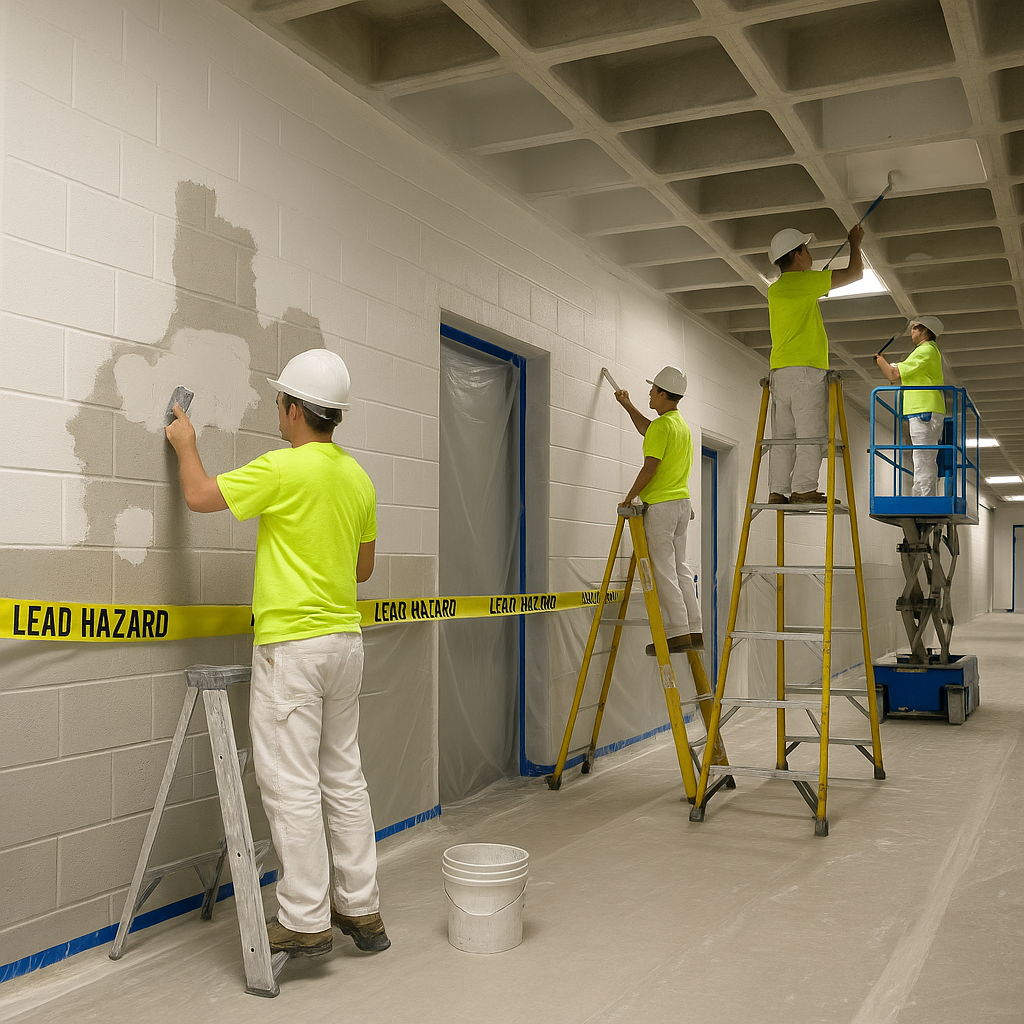
We were hired to patch and paint interior walls at Johnston Hall, Building 29818, Fort Gordon, GA. The Army gave 60 days for completion, but our crew wrapped the job up in 30 days. We kept the work safe, stayed organized, and turned over a clean, finished building a full month ahead of schedule. Finishing early also saved the GC money by reducing how long a lead specialist was needed on site.
Project Information
Client / GC: UD Contracting
Location: Fort Gordon, GA
Scope: Interior wall patching and painting (about 31,730 SF)
Results: Finished in 30 days, zero safety incidents, accepted without issues
Background
Johnston Hall needed wall repairs and a new finish before it could be put back into service. Our scope was straightforward: patch, prime, and paint interior walls. While it may sound simple, older buildings bring challenges. We had to address environmental rules, damaged CMU block, stairwell work, and protection of existing systems — all while keeping the job moving smoothly.
Challenges and How We Handled Them
Lead Paint Oversight
Because of potential lead-based paint, the GC brought in a certified lead specialist. We trained our crew under the EPA Renovation, Repair, and Painting (RRP) program so we could complete the work safely and correctly. By finishing in 30 days, the GC was able to release the specialist a month early, saving costs without compromising safety.
Large Holes in CMU Walls
Some of the CMU walls had large holes that couldn’t be fixed with patching compound alone. We prefilled them with spray foam, let it cure, and then patched over it. That gave us a stable base and a smooth finish once painted.
Stairwell Work
The stairwells required careful attention. We had to patch, prime, and paint stair risers and seal ceiling-to-wall joints with elastomeric caulk. Stairwells are always tricky because they’re tight spaces that people still need access to, so we worked them in phases. The end result was a durable, clean finish in one of the most heavily used parts of the building.
Tight Schedule
The Army allowed 60 days, but we organized the work to be done in half that time. We broke the building into sections: one crew patching, another priming, and another following with paint. That overlap kept progress steady without cutting corners. Finishing in 30 days freed up the GC and the Army to move forward faster than expected.
Protecting Building Systems
The building had raceways, smartboards, vents, and other fixtures that couldn’t get paint on them. We made sure everything was properly masked and covered before spraying or rolling. That attention to detail avoided overspray, rework, or cleanup.
Results
• Finished in 30 days vs. 60 days allowed • GC saved money by releasing the lead specialist early • Zero safety incidents and full RRP compliance • Walls repaired and painted to a smooth, uniform finish • Stairwells patched, sealed, and painted with durable coatings • Final walkthrough accepted on the first pass
Conclusion
Johnston Hall showed what steady, well-planned work can accomplish. We weren’t under pressure to finish early, but by staying organized and efficient, we cut the schedule in half without being asked. Along the way we solved real challenges — from stabilizing CMU walls with foam, to keeping stairwells safe and accessible, to training our people for RRP compliance. We left Johnston Hall better than we found it, finished early, and delivered a product the Army could be confident in. For us, it’s another example of what we tell people all the time: we do it safe, we do it right, and we do it on time.