
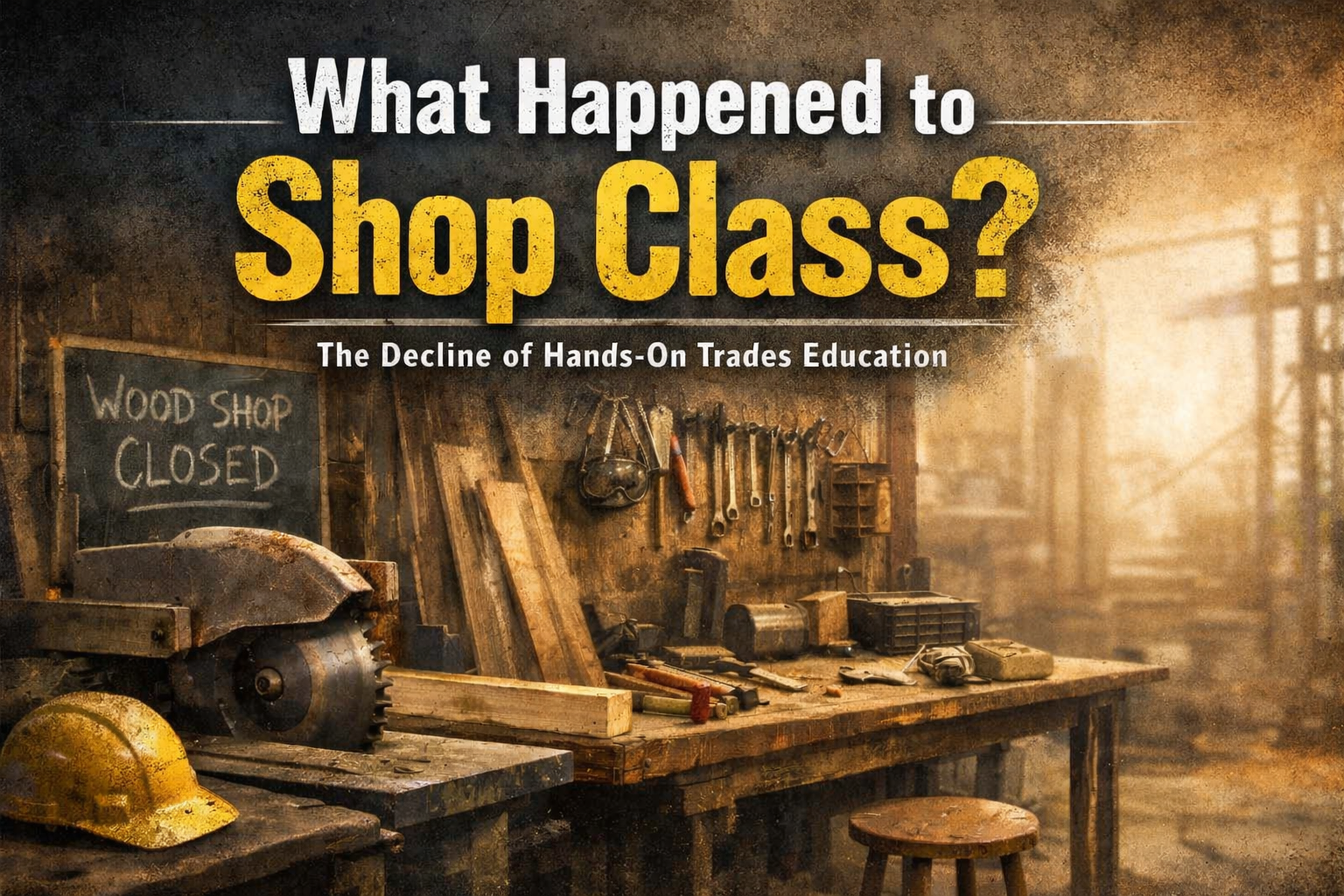
Not long ago, shop class was a normal part of school. Woodworking, metal shop, basic electrical, auto mechanics—these weren’t fringe electives. They were legitimate paths for students who learned best by doing. Somewhere along the way, that changed.
Over time, shop class was quietly pushed aside. Schools began steering nearly every student toward a four-year college track. Trades were reframed as a fallback instead of a profession. Budgets were cut, liability concerns grew, and hands-on programs were labeled “nonessential.” Guidance counselors stopped talking about building things and started talking about degrees.
The result wasn’t immediate, but it was predictable.
Today, the construction trades are paying the price.
We’re facing a workforce gap that can’t be fixed overnight. Contractors across the country are struggling to find young people who understand basic tools, measurements, materials, or jobsite expectations. Many new hires are capable and willing—but they’re starting from zero. They’ve never swung a hammer, read a tape measure, or worked with their hands under supervision.
That learning curve costs time, money, and patience.
Shop class didn’t just teach skills—it taught awareness. How tools work. How materials behave. How to follow steps, think ahead, and respect safety. It taught problem-solving in real time, not on a screen. Most importantly, it introduced students to the idea that building something tangible has value.
When those programs disappeared, so did early exposure to the trades.
Now, many young adults reach their twenties without ever being shown that construction, welding, electrical, plumbing, or painting can be professional, skilled, and financially rewarding careers. By the time they discover the trades, they’re already behind—or convinced they “missed their chance.”
That misconception is hurting the industry.
The construction trades don’t just need bodies. We need trained professionals. People who understand that quality matters, safety matters, and consistency matters. We need workers who see a craft, not just a paycheck. Shop class was often the first spark that lit that mindset.
Without it, contractors are forced to recreate what schools once provided—inside active jobsites, under real deadlines, with real risk. Apprenticeships, mentorship programs, and on-the-job training are more important than ever, but they require structure, patience, and investment. Not every company is equipped to do that well, and the industry feels the strain.
This also affects perception.
When young people never see the trades presented as respectable, skilled professions, the stigma grows. Construction becomes something you “end up in,” not something you choose. That mindset couldn’t be further from reality. The trades offer stability, upward mobility, leadership opportunities, and pride in work that actually lasts.
Buildings don’t exist because someone wrote a paper about them. They exist because someone knew how to build.
The irony is that many of the same skills employers say they want—problem-solving, accountability, teamwork, work ethic—were baked into shop class by default. You couldn’t fake your way through a bad cut or a poor weld. The work told the truth.
So where does that leave us?
If shop class isn’t coming back in force anytime soon, the responsibility shifts to us—the contractors, business owners, and trade professionals. We have to intentionally expose young people to the trades. We have to train, mentor, and show them that this work matters. That it’s skilled. That it’s honorable.
The trades don’t have a talent problem. They have a visibility problem.
Shop class used to be the bridge. Now we have to build a new one.