
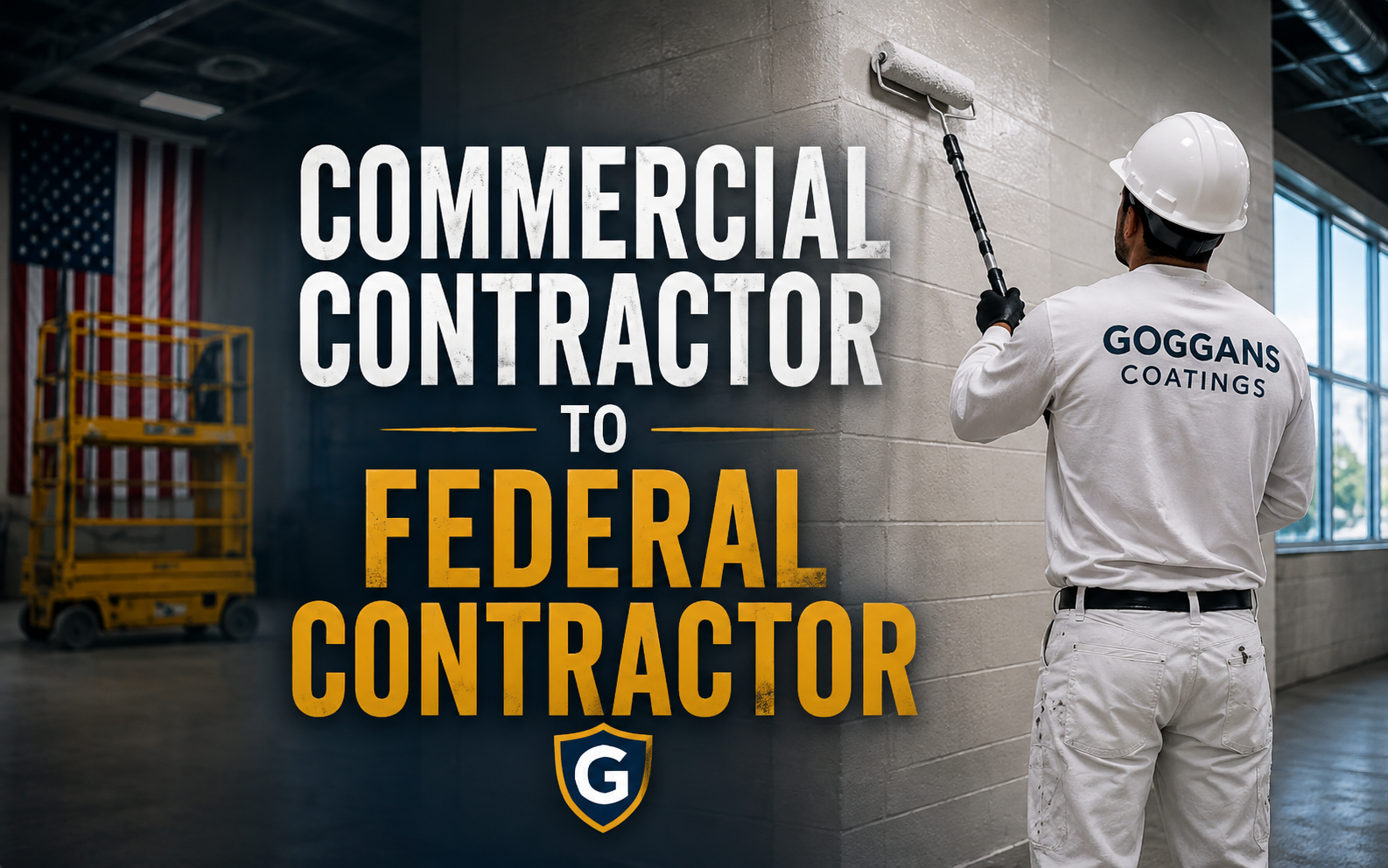
When Goggans Coatings began moving from commercial painting into federal construction, we already knew how to paint.
That wasn't the hard part.
The bigger adjustment was learning how much of the business around the work changes.
For commercial painting contractors considering federal or military projects, there are real opportunities. But there are also differences that can significantly affect estimating, payroll, safety, compliance, cash flow, and project management.
Here are some of the biggest lessons we've learned making that transition.
Your Labor Costs Can Change Dramatically
One of the first things a commercial contractor needs to understand is prevailing wage requirements.
On federal construction projects subject to the Davis-Bacon Act, applicable workers must generally be paid at least the prevailing wage and fringe benefits established for their classification and location.
That can completely change the economics of a project.
A contractor accustomed to estimating with its normal commercial wage structure can't simply carry those labor costs into a federal bid. Wage determinations, fringe benefits, worker classifications, overtime, and apprenticeship requirements all have to be understood before the job is priced.
And the effect goes well beyond payroll.
Higher labor costs affect crew size, production rates, overtime decisions, supervision, and ultimately the price required to perform the work profitably.
Classification matters too. A painter, laborer, and apprentice aren't automatically interchangeable just because employees sometimes perform overlapping tasks in the field. Apprenticeship requirements can be particularly important.
Then there's certified payroll.
Payroll is no longer simply an accounting function. It becomes part of project compliance.
Documentation Becomes Part of Production
Commercial contractors are accustomed to paperwork, but federal construction takes documentation to another level.
Daily reports, certified payroll, submittals, safety documentation, RFIs, change documentation, material information, and other records become part of successfully completing the project.
We've learned that doing the work isn't always enough.
You also need to document what was done, when it happened, who performed it, and, when applicable, who authorized additional work.
Good documentation isn't just paperwork. It protects the contractor and the customer.
Safety and Compliance Become More Structured
Federal and military construction can bring additional requirements such as EM 385, Activity Hazard Analyses, competent-person requirements, specialized oversight, training requirements, and site-specific procedures.
At Johnston Hall at Fort Gordon, potential lead-based paint added another layer of compliance. The general contractor had a separate certified lead specialist on site to oversee the RRP requirements.
The project was scheduled for 60 days, but Goggans Coatings completed its scope in 30 days with zero safety incidents. Finishing a month early also reduced the amount of time the additional specialist was required on site.
That's an important lesson for commercial contractors entering federal work: compliance requirements can affect staffing, scheduling, supervision, and ultimately the cost of performing the project.
Logistics Can Be Completely Different
Federal facilities can create conditions contractors don't encounter on ordinary commercial projects.
During our ANAD Bunkers Upgrades project at Anniston Army Depot, we faced partially underground structures, high humidity, environmental restrictions, no available power, and no on-site water.
We coordinated access to a fire plug, brought in water trailers, supplied our own backflow preventer, adapted our surface-preparation methods, and selected coatings appropriate for the conditions.
Federal work rewards planning—but it also requires the ability to adapt when the plan meets the jobsite.
Cash Flow Matters More Than Ever
This may be one of the most underestimated parts of moving into federal construction.
Payroll happens every week. Payment doesn't.
When prevailing wages and fringe requirements increase weekly payroll, the working capital required to support a project can increase quickly.
Add materials, equipment, retainage, billing cycles, and pending change orders, and a profitable project on paper can still create a serious cash-flow problem.
A contractor therefore needs more than the ability to estimate a profitable federal project. The company also needs the financial capacity and systems to carry that project until the money comes in.
Federal Contracting Changed Our Company
Federal contracting isn't necessarily better or worse than commercial contracting. It's a different environment.
The work still comes down to people showing up, solving problems, producing quality work, and keeping commitments.
But the systems supporting that work have to become stronger.
For Goggans Coatings, moving into federal and military construction has pushed us to improve our documentation, safety, payroll, estimating, scheduling, project management, and financial planning.
And we're still learning.
That's probably the biggest lesson we could share with another commercial contractor considering the move.
Federal contracting didn't require us to become better painters. It required us to become a better company.