
Epoxy Flooring Contractor for Industrial and Federal Facilities
Goggans Coatings installs industrial epoxy floor coating systems for warehouses, motor pools, maintenance bays, and commercial facilities across Alabama and the Southeast. We've applied these systems on federal and military installations, where floors take forklift traffic, chemical exposure, and heavy equipment every day, not the light foot traffic most flooring contractors are used to.
If you're a facilities manager, general contractor, or property owner who needs a floor that holds up under real industrial use, this is what we bring to the job.
Where Epoxy Flooring Gets Used
Epoxy flooring is a resin-based coating system applied over concrete to create a seamless, chemical-resistant surface. It's built for environments where a standard sealed or painted floor won't survive: warehouses running forklift traffic all day, motor pools where vehicles leak oil and hydraulic fluid, maintenance bays exposed to solvents and degreasers, and commercial kitchens or production floors that get pressure washed on a schedule.
Done right, an epoxy floor holds up for years under constant abuse. Done wrong, with the surface prep skipped or rushed, it delaminates, bubbles, or peels within a season. We've been called in to fix both kinds of jobs.
Federal and Military Floor Work
We've installed epoxy floor systems at federal and military facilities including Fort Novosel, Redstone Arsenal, and Maxwell Air Force Base, as part of our broader painting and coatings work on those installations. That work has meant floor coating systems and surface preparation on concrete substrates inside maintenance facilities, motor pools, and warehouse space.
Federal floor work comes with its own requirements: certified payroll, EM 385-compliant safety plans, and coordination with base access and scheduling. We're already set up for that. Our crews carry the same compliance credentials on a floor job that we carry on a painting contract, so there's no separate vetting process if you've already worked with us.
Surface Prep: The Part That Determines Whether the Floor Lasts
Epoxy fails for one reason more than any other: the concrete wasn't prepped correctly before the coating went down. We pay close attention to this step. Our prep process typically includes:
Mechanical grinding or shot blasting to remove existing coatings, laitance, and contamination and to open the concrete pore structure so the epoxy can bond
Moisture testing using in-situ relative humidity probes or calcium chloride testing, so we know what's happening inside the slab before we commit a coating system to it
Surface profile verification to confirm the concrete has the right texture for the epoxy system being installed, since a floor that's too smooth won't hold a coating and one that's too rough will telegraph through it
Concrete that's holding moisture, or that hasn't been profiled correctly, will cause an epoxy floor to fail from underneath no matter how good the topcoat looks on day one. This is where we spend the time other contractors try to save.
Epoxy Systems We Install
Not every floor needs the same system. We install:
100% solids epoxy for high-traffic industrial floors that need maximum chemical and abrasion resistance, including motor pools and maintenance bays
Water-based epoxy for facilities that need lower odor and faster turnaround, including occupied buildings where operations can't shut down for a full cure cycle
Epoxy flake and quartz systems for a broadcast, textured finish that adds slip resistance and hides wear in high-traffic commercial and warehouse floors
Static dissipative epoxy for areas with sensitive electronic equipment where static discharge is a risk
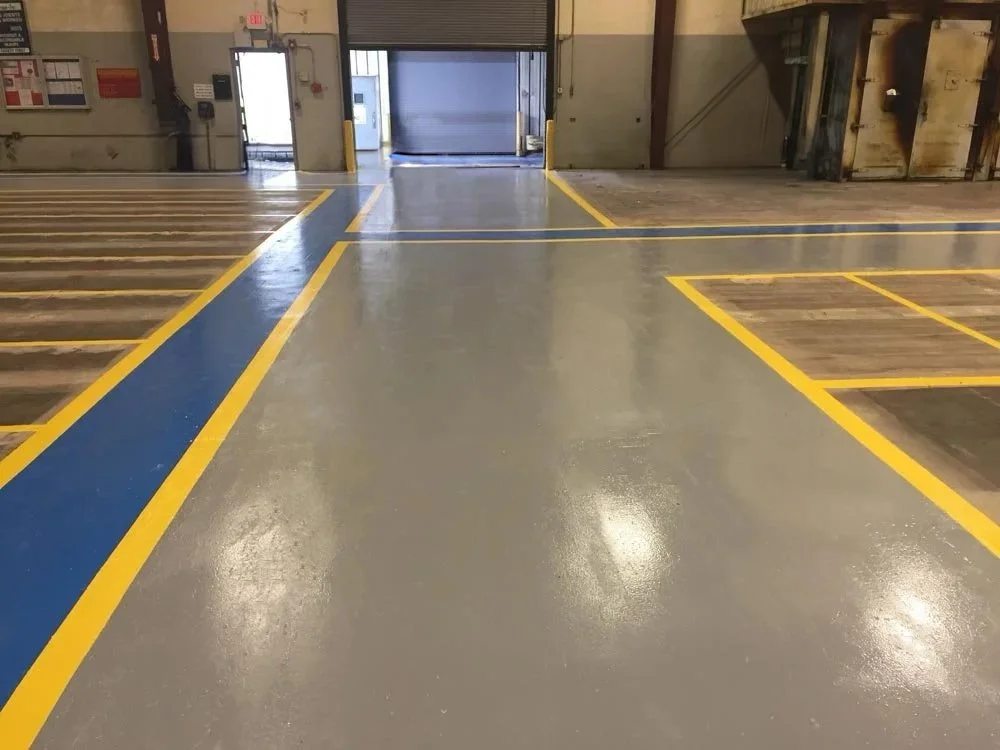
Epoxy cove base and floor striping for forklift lanes, pedestrian walkways, and safety marking required in warehouses and motor pools
We spec the system to the facility, not the other way around. A hangar floor and a break room don't need the same coating.
Certifications & Compliance
Federal project managers can verify the following credentials before award:
We can provide compliance documentation, certificates of insurance, and past performance references specific to federal work upon request.
Active SAM.gov registration / verified CAGE code
NAICS 238320 — Painting and Wall Covering Contractors
OSHA 30-Hour Construction certification
EM 385-1-1 safety plan compliance
Davis-Bacon Act compliance & certified payroll submission
RRP (Renovation, Repair and Painting) certification for lead paint
Alabama contractor's license
Work With Us
We keep a small team, which means the people you talk to are the people doing the work. Shane Goggans runs every job personally, floor jobs included. If you're bidding a warehouse, motor pool, or maintenance facility and need a floor coating contractor who understands industrial and federal requirements, reach out directly.
Follow us on LinkedIn · Follow Us On LinkedIn · Follow us on LinkedIn ·
Follow us on LinkedIn · Follow Us On LinkedIn · Follow us on LinkedIn ·
Frequently Asked Questions
-
We test moisture using in-situ relative humidity probes or calcium chloride testing, and we verify the surface profile before choosing a coating system. Skipping either step is the most common cause of epoxy floor failure.
-
100% solids epoxy is thicker, more chemical and abrasion resistant, and better suited to heavy industrial traffic like motor pools and maintenance bays. Water-based epoxy has lower odor and a faster turnaround, which matters in occupied buildings that can't go offline for long.
-
Yes. Broadcast flake and quartz systems add texture and slip resistance and hold up well in warehouse and commercial floors that see heavy foot and equipment traffic.
-
Yes. We regularly work as a painting subcontractor under primes holding MATOC, SATOC, and JOC vehicles. We're familiar with the subcontractor vetting process and can turn around compliance documentation quickly.
-
Yes. We schedule around operations and can recommend faster-curing systems where a facility can't shut down for an extended period.
-
Yes. We install static dissipative systems where equipment sensitivity requires it, including on federal and military facilities with that requirement.
-
Yes. Floor striping, forklift lanes, and pedestrian walkway marking are part of the same scope as the epoxy installation, not a separate contractor.