
Walk into almost any contractor’s shop and you’ll see it.
Tools are locked up. Equipment gets serviced. Sprayers get cleaned. Lifts get inspected. Trucks get oil changes.
And they should.
A contractor who doesn’t take care of his tools won’t stay in business very long.
But here’s the question I’ve been thinking about:
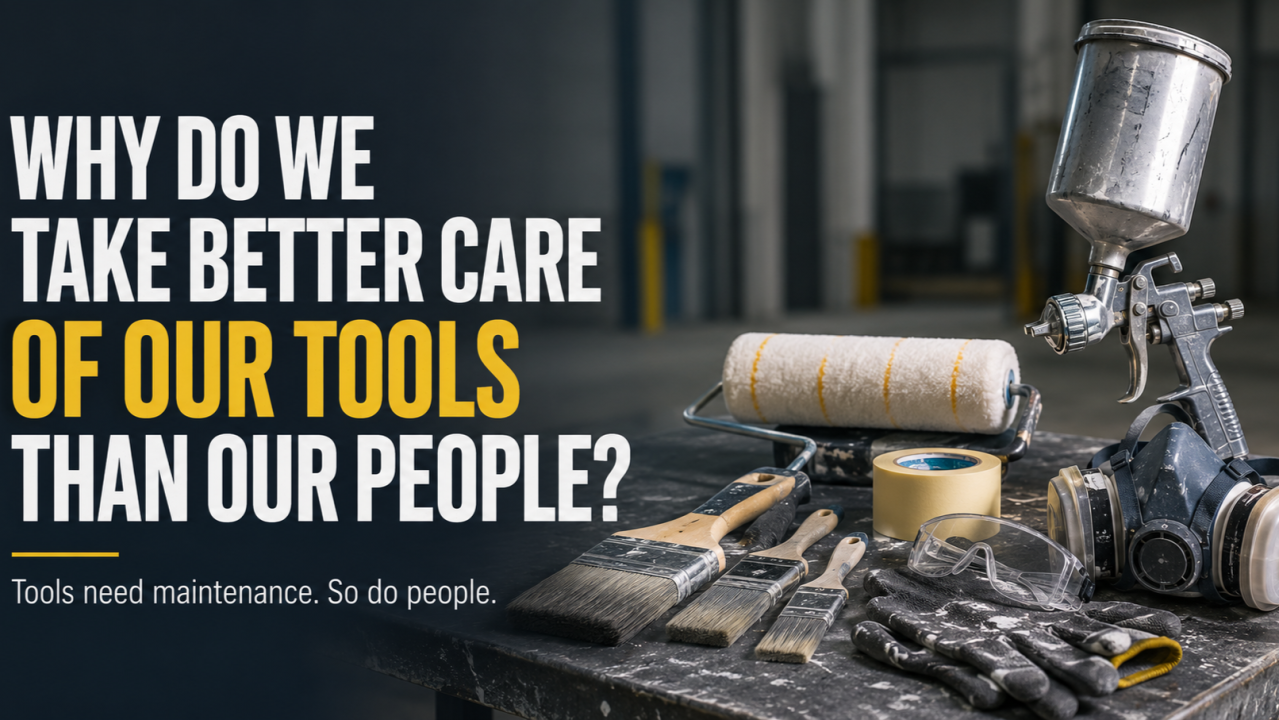
Why do we sometimes take better care of our tools than we do our people?
And I’ll be honest — I’m guilty of this too.
It’s easy to notice when a tool gets neglected. It’s easy to see when equipment needs maintenance, when a sprayer needs cleaning, or when a truck needs service.
It’s not always as easy to notice when a person needs more training, clearer direction, better communication, or just a reminder that they matter.
That’s something I want to get better at.
Not because I think standards should be lower. I don’t.
But because if I expect people to perform like professionals, then I need to do my part in helping them become professionals.
Tools don’t show up early.
Tools don’t stay late.
Tools don’t figure out how to keep a job moving when conditions change.
Tools don’t protect your reputation when nobody is watching.
People do.
In the painting and coatings business, we depend heavily on tools and equipment. Spray rigs, lifts, pressure washers, grinders, sanders, safety gear, trucks — all of it matters.
If a machine goes down, production suffers.
But when a person breaks down, burns out, gets ignored, or never gets trained, the damage is usually worse.
It may not show up on a repair invoice.
But it shows up.
It shows up in poor workmanship. It shows up in callbacks. It shows up in turnover. It shows up in safety issues. It shows up in missed details. It shows up in a crew that stops caring because they don’t feel like anyone cares about them.
That is not how a professional trade should operate.
Taking care of people does not mean lowering standards.
Actually, I believe it means the opposite.
It means giving people clear expectations.
It means training them instead of just criticizing them.
It means providing the right PPE.
It means making sure they understand why the prep matters, why the schedule matters, and why safety matters.
It means giving them a path to grow instead of leaving them stuck forever as “just labor.”
A good tool needs maintenance.
So does a good employee.
That maintenance looks like communication, coaching, accountability, opportunity, and respect.
We would never throw an expensive sprayer in the back of a truck full of dried paint, leave it there for six months, and then act shocked when it doesn’t work right.
But too often, companies hire people, give them little direction, no real training, no clear future, and then wonder why they don’t perform.
That’s on leadership.
And I’m not writing this like I have it all figured out.
I’m writing it because I know this is an area where I need to improve.
The best crews I’ve been around are not built by accident. They are built by steady expectations, good systems, and leaders who understand that people are not disposable.
A company can buy more tools.
Finding, training, and keeping good people is much harder.
And if we say we care about quality, safety, and professionalism, then we have to care about the people doing the work.
Because at the end of the day, our reputation is not carried by our tools.
It is carried by our people.