
What federal and commercial contractors should know about coating selection, surface conditions, and preventing costly rework.
A painting specification may look straightforward on paper. It identifies the surfaces, preparation requirements, primers, finish coats, and application procedures needed to complete the work.
But once a crew arrives on the jobsite, the actual conditions don't always line up neatly with what was anticipated during design.
Concrete may hold more moisture than expected. Existing steel may have significant corrosion. Temperature and humidity may affect coating application and curing. Sometimes, access to water, electricity, or other basic resources is limited.
At Goggans Coatings, we've learned that successful commercial and federal painting projects require more than following a list of specified products. They require understanding how those products will perform under actual field conditions—and knowing when additional clarification is necessary.
A Specification Is the Starting Point, Not a Substitute for Field Verification
Specifications establish the requirements for a project. They are essential to maintaining quality, consistency, and accountability.
However, a specification cannot account for every condition that may be discovered once work begins.
Before applying a coating system, contractors need to evaluate the actual substrate and surrounding environment.
Some of the most important considerations include:
Surface moisture: Excess moisture can affect coating adhesion, curing, and long-term performance.
Existing coatings: Previous finishes may require compatibility testing, additional preparation, or removal.
Corrosion: Steel deterioration may require more extensive preparation than initially anticipated.
Temperature and humidity: Application and curing conditions must comply with the coating manufacturer's requirements.
Surface contamination: Oil, dirt, salts, and other contaminants can compromise an otherwise properly specified coating system.
A coating can meet every requirement on the product data sheet and still fail if the substrate or application conditions are unsuitable.
That's why field verification should happen before production painting begins—not after a problem develops.
A Real Example: Anniston Army Depot Bunker Upgrades
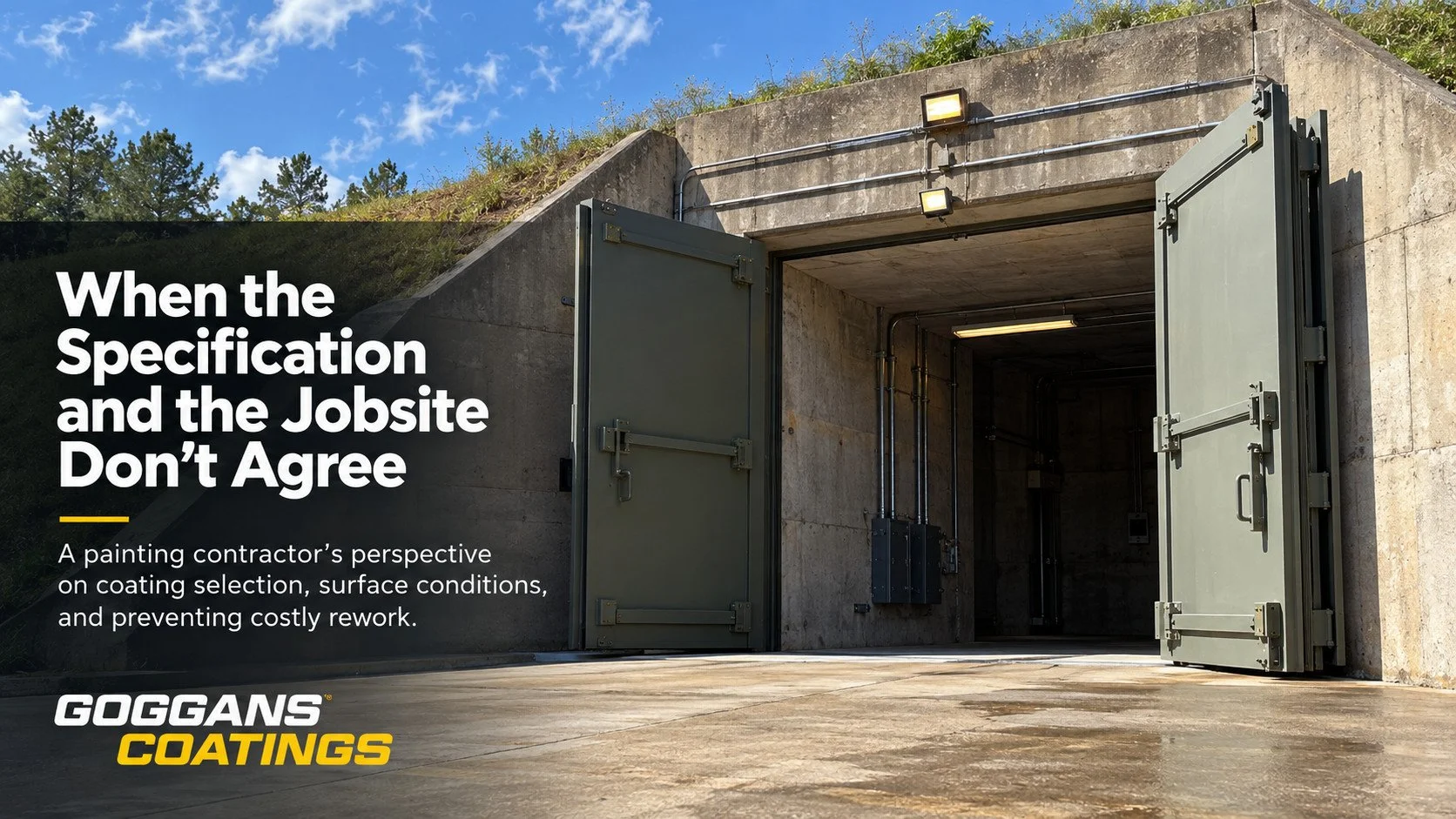
One project that reinforced the importance of understanding field conditions was our bunker upgrades project at Anniston Army Depot in Alabama.
Working for Bates Engineering and Construction, Goggans Coatings was responsible for pressure washing and coating interior concrete surfaces, cleaning exterior head walls, and preparing and painting heavily corroded steel bunker doors.
These weren't typical aboveground buildings.
The partially underground bunkers presented high-humidity conditions that could affect coating performance. The site also had limited access to electricity, no readily available water supply, and restrictions prohibiting detergent use.
Those conditions influenced how we approached the work.
To address the humidity concerns, our crews completed pressure washing well ahead of coating application, used a moisture-curing primer, and applied an exterior-grade finish coating. We also used fans where practical to improve airflow.
For the corroded steel doors, our crews performed power-tool cleaning before applying a rust-preventative primer and high-performance alkyd enamel.
The cleaning restrictions required another adjustment. Instead of relying on detergents, we used high-pressure washing equipment with oscillating tips. We also coordinated access to a water source and supplied water trailers and backflow protection.
The project was completed ahead of schedule, with zero reported safety incidents and a minimal punch list.
The lesson wasn't that specifications should be ignored. It was that understanding the actual conditions, selecting appropriate methods, and planning the work around site restrictions are essential to delivering the specified result.
When Conditions Require Clarification, Document Them
Not every field condition can be resolved by changing the sequence of work or adjusting application methods.
Sometimes, the specified coating system may not be appropriate for the conditions encountered.
When that happens, the answer isn't to quietly substitute a different product.
The contractor should document the condition, review the manufacturer's requirements, and communicate with the general contractor or other authorized project representatives.
Depending on the issue, that may involve a request for information (RFI), additional testing, a proposed alternative coating system, or formal approval before proceeding.
On federal and military construction projects, those documentation and approval procedures can be particularly important.
A field decision that seems minor at the time can become a significant problem if the coating fails or the installed system doesn't match the approved submittals.
The Cost of Getting It Wrong
Coating failures rarely affect only the painting subcontractor.
They can delay other trades, interfere with building turnover, create additional inspections, and require costly surface preparation and reapplication.
A problem discovered during preconstruction or early field verification is generally easier to address than one discovered after thousands of square feet have been coated.
For general contractors and project managers, this is one reason the qualifications and experience of a painting subcontractor matter.
The lowest initial price doesn't necessarily reflect the contractor's ability to identify potential coating problems before they affect the project.
Good Painting Contractors Solve Problems Before They Become Failures
At Goggans Coatings, we believe successful painting and industrial coatings work starts long before the first finish coat is applied.
It starts with understanding the specifications, evaluating the substrate, coordinating with the project team, and making sure the selected coating system can be installed under the conditions that actually exist.
Whether we're working on a commercial facility, an industrial building, or a federal installation, the objective remains the same: deliver a durable, compliant finish without creating unnecessary problems for the project.
A good coating system matters. Knowing when and how to apply it matters just as much.
About Goggans Coatings
Goggans Coatings is an Alabama-based commercial, industrial, and federal painting contractor serving government, military, and commercial construction projects throughout the Southeast. Our services include interior and exterior painting, industrial coatings, epoxy flooring, surface preparation, and related specialty finishes.
Learn more at www.gogganscoatings.com.